
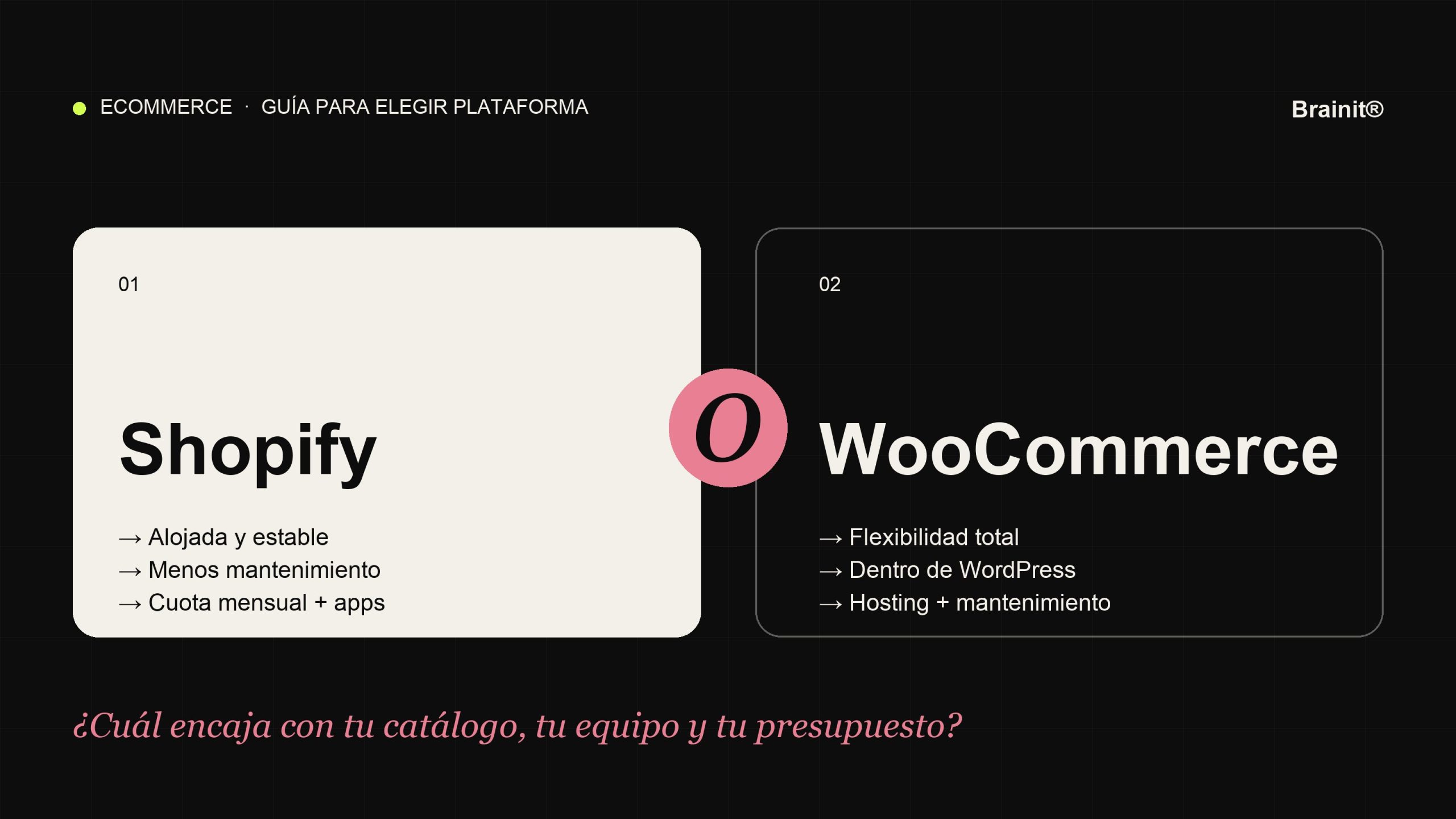
It’s the question we get asked most before starting an online store. And the honest answer is that neither platform is better than the other: one of them fits your catalogue, your team and your budget. These are the five questions we use to decide with every client.
The difference in one sentence
Shopify is a hosted platform: you pay a monthly fee and Shopify takes care of the server, security and updates. WooCommerce is a WordPress plugin: the store lives on your own hosting, it’s entirely yours and you can change it as much as you need, but someone has to maintain it.
1. Who will maintain the store?
If you have no technical person close by and want to forget about updates, backups and servers, Shopify takes that work off your plate. With WooCommerce that maintenance exists, and it’s best to have it sorted from day one, either with your own team or with a maintenance service.
2. How special is your catalogue?
For a catalogue with simple products and variants, both platforms work very well. When special rules come in (customer-specific pricing, configurators, made-to-order products, wholesale and retail in the same store), WooCommerce usually gives you more room because you can build exactly what you need. On Shopify many of those features are solved with paid apps or with development within its limits.
3. What does the store need to talk to?
Before choosing, list what you already use: ERP, invoicing, payment gateway, carriers, CRM, marketplaces. Check which integrations exist on each platform for your country, because selling from the US is not the same as selling from Spain or Chile. This list often decides more than anything else.
4. What does it really cost?
Compare over three years, not the first month:
- Shopify: the monthly plan fee, the paid apps you add along the way and, if you don’t use its payment gateway, transaction fees.
- WooCommerce: quality hosting, premium plugins, maintenance and updates.
A Shopify store with lots of apps can end up costing more than a well-maintained WooCommerce store, and the other way round. What matters is running the numbers with your own figures.
5. What role do content and SEO play?
Both platforms can rank a store well if the structure, product pages and speed are done right. If your strategy relies heavily on content (blog, guides, landing pages), WooCommerce has the advantage of living inside WordPress, with everything in one place. Shopify has a blog, but it’s more limited for large editorial projects.
Summary: when we choose each one
We choose Shopify when the client wants to launch quickly, has no technical team, has a standard catalogue and prefers to pay a fee in exchange for stability.
We choose WooCommerce when the catalogue has its own rules, there are custom integrations, content is key or the client wants full control over their store and their data.
What if you already have a store?
Moving from one platform to the other is possible: products, customers and orders can be migrated, and the most important thing is to take care of URLs and redirects so you don’t lose the rankings you already have on Google.
At Brainit we design and build stores on both platforms. If you’re unsure about your case, tell us what you sell and we’ll tell you which one we would choose.